Available in: Norsk
Most Organizations Don't Have a Technology Problem. They Have a Decision Problem.
Part of framework
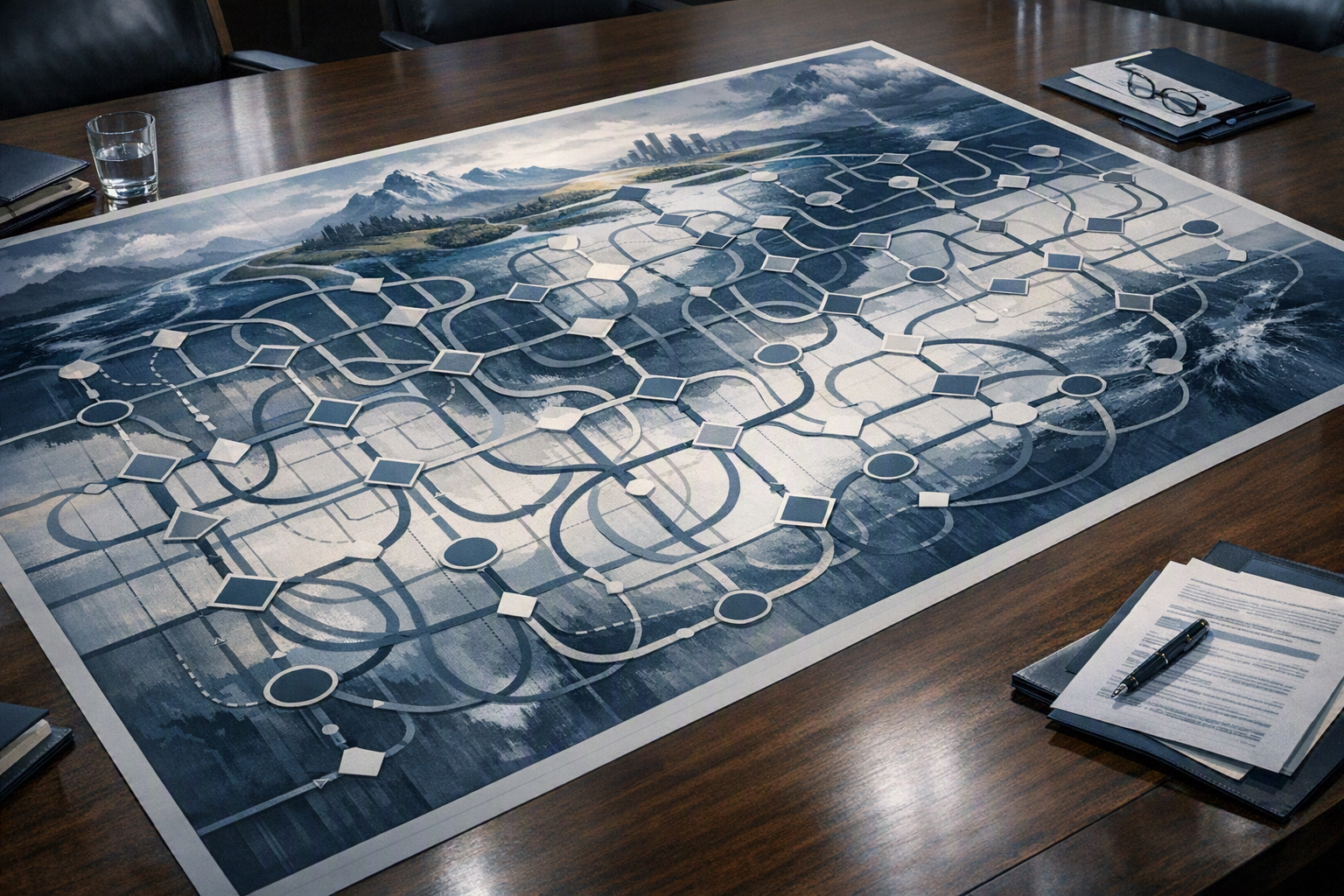
We talk a lot about technology. We talk about cloud platforms, artificial intelligence, modern architecture, product organizations, and digital transformation. When organizations run into trouble, this is usually where attention turns. New processes get introduced. Reorganizations happen. Money gets invested in new technology. New governance models get rolled out.
And yet many organizations keep facing the same problems, year after year. Decisions take too long. Accountability is unclear. Initiatives lose momentum. The same discussions happen over and over. Leaders get pulled into details that should have been handled much closer to the problem. Teams become dependent on escalation just to move forward.
At first glance, this looks like a technology problem, a process problem, or an organizational problem. In my experience, it's often a symptom of something more fundamental: a decision-making problem.
Organizations Are Built Through Decisions
Every organization is the sum of the decisions made over time, strategies, products, technology choices, and organizational structures are all decisions, and what we see today is largely the consequence of decisions made yesterday. I go deeper into this in Introducing the Decision Architecture Framework.
The Problem Is Rarely a Lack of Competence
Most organizations are made up of capable people, yet disagreement, slowness, and uncertainty still show up constantly, because people rarely operate with the same context. What looks like disagreement about a solution is often disagreement about how the problem is understood in the first place, something I explore further in Introducing the Decision Architecture Framework.
Strong Opinions Aren't the Same as Good Decisions
Most organizations have people with strong opinions. Some have deep experience. Some hold formal authority. Some have built up significant influence over time. None of that is inherently bad, experience is valuable, and authority can be necessary.
The problem arises when the quality of a decision is shaped more by who is arguing than by the strength of the argument itself. When that happens, the organization risks optimizing for influence instead of insight. Good decisions require that alternatives, assumptions, and consequences can be discussed openly, not to win a debate, but to increase the odds of making a sound choice.
Decisions Need to Withstand the Passage of Time
A problem I run into often is that, months or years later, nobody quite remembers why a decision was made. Questions start coming up: why did we choose this solution, what alternatives did we consider, what assumptions did we rely on, and what trade-offs did we accept? More often than not, there are no good answers. The context has been forgotten, the people involved have moved on, and the documentation is missing.
At that point, the organization loses the ability to learn from it. It also becomes hard to tell whether the decision still holds up given today's situation. A good decision isn't just about being right in the moment. It should also be understandable in hindsight.
Maybe We're Optimizing for the Wrong Thing
Many organizations try to make perfect decisions. That sounds reasonable, but I think it's the wrong goal. Reality is uncertain, information is incomplete, assumptions will turn out to be wrong, and conditions will change. No method can guarantee correct decisions.
The goal, then, shouldn't be to eliminate mistakes. The goal should be to reduce the consequences of mistakes and increase the ability to learn from them. Organizations that learn quickly can survive bad decisions. Organizations that learn slowly can fail even after making good ones. The capacity to learn is often more important than the ability to predict the future.
Decisions Are Also a Matter of Culture
Tools help. Methods help. Frameworks help. But none of them can make up for a culture that punishes questions, challenges, and alternative perspectives. An organization that wants better decisions also needs to build a culture where it's safe to challenge assumptions, ask questions, discuss alternatives, acknowledge uncertainty, and revisit past decisions. Without that, the decision-making process easily becomes a formality.
Toward a Decision Architecture
Over the past few years, I've become increasingly focused on what I call decision architecture. Not as a governance model, not as a process, and not as another layer of bureaucracy, but as the design of an organization's ability to make, challenge, document, and improve decisions over time.
The starting point is simple: organizations don't succeed because they always make the right decisions. They succeed because they build systems that allow them to learn, adapt, and improve their decisions as they go. That's where decision architecture begins.
Closing Thought
We often ask: how do we make sure we're making the right decision? Maybe a better question is: how do we build organizations that learn faster than the consequences of bad decisions can unfold? In a world defined by uncertainty, it's rarely the people who are always right who succeed. It's the ones who learn the fastest.
Further Work
This article is part of an ongoing effort to develop the Decision Architecture Framework. The framework explores how organizations can strengthen their ability to make, challenge, document, and learn from decisions over time. More articles on this topic will follow as the work progresses.
Share this article
Related articles
When Everything Is Shared, Nobody Owns It
Many organizations are not slowed down by a lack of capability. They are slowed down by unclear ownership.
The Urgency Trap
Many organizations are not slowed down by resistance. They are slowed down by competent people solving the right problems at the wrong time.
Simplicity Is Also a Strategy
Many organizations try to solve problems by adding more. More teams. More processes. More systems. Yet the solution is often found in the opposite direction. Simplicity is not the absence of strategy. Simplicity is the result of good strategic choices.